

Rehab
Getting Sober Was the Easy Part...Issue #138
It started at lunch.
My dad had asked me to join him. When we walked into the restaurant, we weren’t seated at our usual table. Instead, we were ushered into the private back room. The door shut behind us.
That’s when I saw my mother and my oldest sister sitting there.
We didn’t have a good relationship. Seeing my sister triggered something immediate—anger, suspicion, betrayal. I asked why she was there. My Mom said, “She loves you.” She smirked. It didn’t feel like love.
There was an uneasy atmosphere as we gathered at the table. I was seated between my mother and father. An uncomfortable place for me, as I always liked to sit on the outside—because I’m left-handed.

My mother looked at me and asked,
“Are you doing drugs, Ollie?”
I was in shock.
When she asked again, I lost it.
“Yes,” I said.
“What are you doing?”
“Everything.”
“Which ones?”
“All of them.”
I wasn’t calm. I wasn’t thinking. I was fuming.
I assumed that if there were going to be an intervention, I’d know about it. Instead, I felt ambushed. Every question made me angrier. I wanted my sister to leave, and I said it. No one listened.
So I lied. A lot.
I wasn’t buying heroin on the street—I wasn’t doing that—but I didn’t care. I said everything because I was no longer myself.
I regretted leaving Dallas. I was working without hope, clinging to the idea that maybe—just maybe—five, seven, eight years from now my dad would step down and I’d take over the company.
Or maybe he’d say, “Pay me monthly, and you can run it.”
I was angry at my mom for what felt like stealing my life from me—my chance to become president of a great company, now a shadow of itself.
All because she didn’t like that I took her up on her offer to call the company lawyer.
I was pissed.
I was not in my right mind.
“You’re coming with me, Ollie,” my mom said sternly.
I agreed, thinking I was just going to dry out. I’d already been sober for four days. That’s all I thought this was.
The next thing I knew, we were flying to my mom’s home in Palm Springs.
Not driving. Flying. She wanted me there fast.
When we settled in, she told me I’d be going to the Betty Ford Clinic in a few days.

The normal wait was months.
How did she pull that off?
I kept asking myself how this even happened. I never drank or used drugs while working. Maybe my dad or my sister smelled it on me—alcohol sweating through my skin. That happens, you know.
My mom and I didn’t talk much while we waited. There was too much resentment—being removed from the line of succession, years of unresolved history between us.
We never talked deeply about my pain. I never learned how to start conversations that might lead to conflict. I avoided them. I avoided my own voice.
Writing was the only place it came out.
I wasn’t whole. I couldn’t speak freely—from my mind or my heart. That shaped my entire life.
Arriving at rehab was nerve-racking.
But I wanted it.
I had been sober six years and four months before I broke. I wanted Ollie back. If this was the path, then so be it.
They took my vitals. Opened my suitcase. Went through everything—every pocket, every seam. They found sleeping pills.
“No, Ollie, you can’t have any of these.”
They removed them, logged them, and took me to my room.
That’s where I met my roommate.
He was a heart surgeon. A man of color. Warm. Gentle. Loving. I felt it instantly. When we shook hands, I felt welcomed—truly welcomed—for the first time in a long while.
Rehab is a controlled environment. No caffeine. No sugar. They don’t want you replacing one high with another.
Root beer became my thing.
We all carried The Big Book—Alcoholics Anonymous, first written in 1939 by William G. Wilson. He is known worldwide as Bill W, within the AA community.
Every minute of the day was planned out. Thirty days minimum. Then they’d decide whether I needed a halfway house for three to six months.
I did not want that.
My relapse had been just over four months. I was determined to do everything right.
The routines were strict, the rules clear. Yet freedom felt distant. Every day was measured—medications, meetings, therapy sessions, and chores. And through it all, the quiet question lingered: how much of my life had I actually lived, and how much had been swallowed by choices I couldn’t undo?
I met others, each carrying a version of my story—loss, betrayal, hope, fear. We shared fragments, confessions whispered in corners of rooms where no one else could hear. There was comfort in this quiet camaraderie. Pain was still pain. Alone, it was unbearable; together, it was something we could name.
Some nights, I lay awake staring at a ceiling I didn’t own, feeling the tug of everything I’d left behind—the business, the betrayals, the people I’d hurt and who had hurt me. Rehab wasn’t a cure; it was a pause. A space to confront the truth I’d been running from, to start learning who I might be if I survived it.
And beneath the dread and loneliness, there was a flicker—fragile, almost laughable—that maybe, just maybe, I could find a way back to myself.
During these first days in rehab, the world outside shifted quite literally. A major earthquake struck San Francisco during the World Series, the tremor carrying far beyond the Bay Area. Even out in the desert, the ground shuddered. Walls creaked. Something deep and unsettled moved beneath my feet. I was shaken — not just by the quake itself, but by the strange recognition that, while everything around me felt unstable, I had grown up living on fractured ground.
Mornings started with breakfast—real, healthy food. Then class. Not school like you remember, but counseling. Sharing. Listening. Participating.
No hiding.
Lunch with everyone. Then activities. I chose volleyball—out in the September desert sun. Sweating it out felt like healing.
They didn’t miss a thing medically. Staff members escorted us to the hospital next door for complete evaluations—blood work, X-rays, scans, MRIs. It took over a week.
I came out clean.
That mattered.
But the real work was the Twelve Steps. That’s what the Betty Ford Clinic teaches. We lived by them.
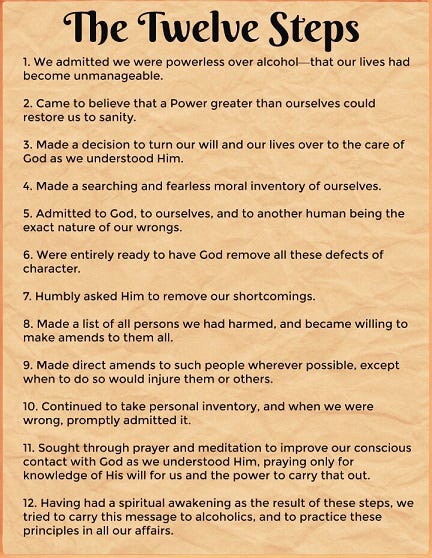
Here’s how they unfolded for me.
I admitted powerlessness.
I believed in a higher power.
I turned my life over to God.
I took inventory—deep, painful, honest.
I admitted my wrongs—to God and to a non-denominational priest.
I’ll never forget sitting on that bench for hours.
I asked for my defects to be removed.
I asked for my shortcomings to be lifted.
I began the process of making amends.
Some happened quickly. Some later. Some took years.
I couldn’t face Laurie, my girlfriend from university, in person. Not because I didn’t want to. I didn’t know where she was. I wrote her an eight-page letter. Told the truth. Sent it to her last known address.
She never responded.
I understood.
The remaining steps became daily practice—honesty, reflection, prayer, service.
I was changing.
Then came parents’ day.
My mom and I sat on my bed. My dad sat on my roommate’s bed across from us.
This was my chance.
All I could ask my dad—after all those years—was,
“Why have you never told me you love me?”
He sat in silence.
No words. No explanation.
I didn’t talk about the trips my mom canceled.
A month in Sweden.
A month on a private yacht sailing around the Greek Islands.
I didn’t talk about the promise that I would train beside her for six months, then take over as president of the company.
I didn’t talk about the damage it did to my identity.
But it lived inside me.
Always has.
I was grateful for this gift from my parents. Truly. Rehab saved my life.
When I completed my thirty days, I felt like a new person—clear-headed, full of hopes and dreams.
I had never been happier. My future looked bright.
I continued with AA for years, attending groups made up only of Betty Ford alumni.
Same language. Same commitment.
Reflection
Rehab didn’t just sober me up.
It stripped me down to the truth.
And the truth was this: I was willing to do the work to change, but the world I returned to was still willing to take advantage of the man I’d been trained to be.
Still, I wanted Ollie back.
And I got him.
I returned sober, committed, and ready to build something new.
I didn’t yet understand that recovery doesn’t protect you from betrayal—it only makes you clear enough to see it.
If you’ve ever had to sit still long enough to face the truth about yourself, I’d love to hear what that moment looked like for you.
Subscribe for access to Ollie - ifOnlyi…
Every story, every lesson, every chapter — delivered directly to your inbox. No algorithms. No ads. Just the truth as it happened, and the reflections I wish I’d understood sooner.
This is a fascinating memoir of a turning point in your life, Ollie. You narrated the story with problems and ended with sustainable solutions. I heard a lot about this 12-step rehab program, which helped many people. Thank you for sharing your personal stories transparently and in an engaging way, giving us valuable perspectives.